Case study
HighCom Armor: From One Email to a Shared Operational Brain

~8 hrs
Email prompt to a four-scenario planning analysis
94 days
Planning horizon simulated from a single email prompt
100+
Recurring documents generated through automated workflows
97%
Month-end forecast accuracy at June close
In late March 2026, HighCom Armor’s leadership sent the ProDex team a single email. Two large customer orders were due in close succession, while material availability, hiring plans, production schedules, and delivery commitments all had to be balanced simultaneously. Multiple decisions competed for immediate attention, each carrying implications for cost, schedule, and operational performance.
Approximately eight hours later, HighCom received a four-scenario analysis spanning a 94-day planning horizon — a delivery answer, a hiring plan, and every assumption the model made, listed. What began as a planning exercise soon evolved into something much larger. Today, ProDex supports production planning, revenue forecasting, inventory analytics, executive reporting, compliance documentation, and opportunity evaluation across HighCom’s operations — more than 100 recurring business documents generated through automated workflows.
“We originally started using ProDex to help us answer difficult production planning questions. What quickly became apparent was that the platform could do far more than simulation. Today it supports our production planning, revenue forecasting, executive reporting, inventory analysis, bid reviews, and operational decision-making.”
About the customer
HighCom Armor is a Columbus, Ohio–based manufacturer of NIJ-certified hard and soft body armor, ballistic plates, and personal protective equipment. Demand is contract-driven, requiring leadership to balance customer delivery commitments, supplier schedules, workforce planning, and production capacity across a rapidly changing environment.
Like many growing manufacturers, critical business information existed across ERP exports, spreadsheets, production schedules, forecasts, inventory records, and the knowledge of experienced personnel. As operational complexity increased, leadership sought more effective ways to evaluate options, assess risk, and support decision-making across the business.
The email that started it
The engagement began with a single email.
A significant production planning challenge required leadership to understand how multiple operational variables would affect upcoming customer deliveries. Staffing plans, material availability, transportation decisions, and production schedules all interacted in ways that made traditional spreadsheet-based analysis both time-consuming and difficult to maintain.
Rather than requesting a static report, HighCom wanted a practical answer to a business question:
“We are looking for recommended staffing levels, hiring timelines, and whether air freight versus ocean freight impacts our ability to execute. If possible, provide best case, expected, and worst case scenarios so we can make decisions quickly.”
Producing a credible answer traditionally would have required multiple days of data gathering, spreadsheet modeling, assumption validation, and scenario analysis. The challenge was not expertise — the team understood its operations — but rather the effort required to evaluate multiple possibilities quickly enough for the results to remain actionable.
From one email to a four-scenario plan
The email itself became the input. ProDex’s agent took the message as written and layered its requirements — resource constraints, scheduling considerations, operational priorities — onto a discrete-event simulation model built from HighCom’s own bill-of-materials and routing data. No model builder was opened and no scenarios were hand-assembled: the interface to the simulation was the email itself, and the team evaluated multiple alternatives through a single planning workflow.
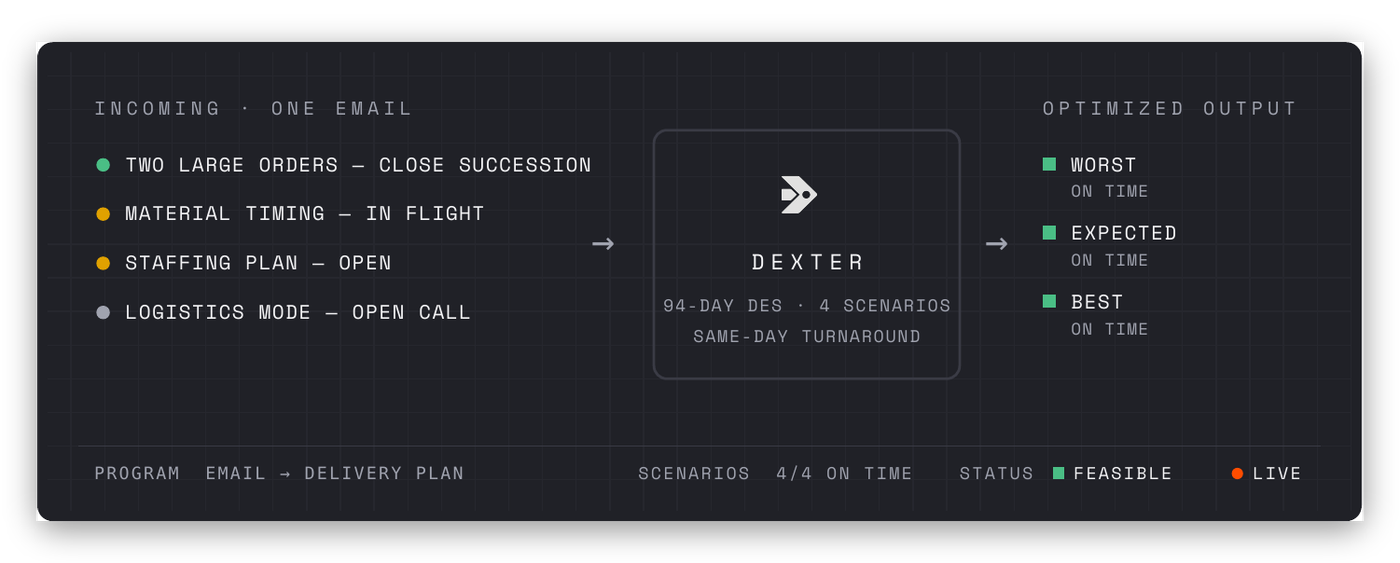
Where inputs required clarification, the system surfaced questions rather than making assumptions silently. Every assumption was documented and presented alongside the final recommendations, giving leadership visibility into both the analysis and the conditions under which it remained valid.
Because the underlying information included operational, production, and commercial data, HighCom’s use of ProDex was implemented within company-approved data governance and information security requirements. The platform was evaluated not only on its analytical capabilities, but also on its ability to support appropriate control of business data, assumptions, workflows, and outputs.
The turnaround:
- Before ProDex — A multi-day analytical effort to gather data, build scenarios, validate assumptions, and produce recommendations.
- After ProDex — Approximately eight hours from initial email to a delivered four-scenario analysis across a 94-day planning horizon.
What the model found
The value of the exercise was not simply producing scenarios — it was understanding which decisions mattered most. The analysis demonstrated that HighCom could meet its delivery commitments in all four modeled scenarios, with schedule margin ranging from days in the most conservative case to roughly a month in the best — and it traced that full range to a small number of decisions.
Identifying the highest-impact decisions.
The analysis identified a small number of operational decisions that had an outsized impact on schedule confidence. By evaluating alternative logistics, staffing, and production scenarios simultaneously, leadership was able to understand which actions materially improved delivery performance and which did not justify the additional cost.
Knowing what not to change.
Just as importantly, the analysis provided clarity on where additional spending and intervention were unnecessary. Leadership gained confidence in which variables required attention and which could remain unchanged without increasing delivery risk. Permission to not spend, not over-staff, and not over-rotate is often the highest-ROI output of a well-built simulation.
Challenging assumptions.
The model challenged several assumptions about where capacity constraints were most likely to emerge. Rather than relying solely on intuition, HighCom was able to focus resources on the activities with the greatest projected impact on operational performance. Staffing and planning recommendations could then be prioritized according to their expected business value.
Transparency and trust.
Every assumption was documented and visible. When inputs were uncertain, the model surfaced those uncertainties rather than masking them. The final report closed with: “If any of these assumptions do not hold, the results may change materially and the model should be re-run.” That transparency helped make the resulting decisions more trustworthy, defensible, and actionable.
“All my sales orders, my back order report, my bill of materials and dates — can I feed it all in, and you tell us where it breaks?”
From a one-off analysis to an operating platform
That question became the roadmap. What started as a single planning exercise evolved into a broader operational platform supporting multiple business functions. Rather than beginning each new analysis from scratch, the platform retains institutional knowledge, planning assumptions, reporting standards, and business context — so each new workflow builds upon prior work.
What ProDex supports at HighCom today:
| Function | What it covers |
|---|---|
| Production planning | Automated planning workflows supporting operational execution and delivery priorities |
| Revenue forecasting | Executive-level forecasting and business performance analysis |
| Inventory analytics | Automated inventory reporting and decision-support analysis |
| Compliance documentation | Automated support for regulatory and customer documentation requirements |
| Opportunity support | Bid evaluation, schedule analysis, and opportunity review workflows — up to a dozen bid documents reviewed in a single pass, including non-English packages |
| Executive reporting | Standardized recurring management reporting |
| Manufacturing simulation | Capacity planning and operational modeling supporting growth and investment decisions |
Program impact to date:
| Result | Detail |
|---|---|
| 100+ | Recurring business documents generated through automated workflows |
| ~97% | Forecast accuracy at June month-end close — a result that drew interest from the wider HighCom Group |
| 80 | Certificates of conformity generated in minutes from a year of sales history — an audit request that arrived on a Friday afternoon, closed out the same day |
| Weekly | Production planning standardized and automated |
| Recurring | Executive forecasting established as a repeatable process |
| Knowledge base | Operational knowledge organized into a reusable intelligence framework that compounds with every analysis |
The throughline: the interface never changed. HighCom asks questions in plain language — the way the first email did — and the platform answers from a model that already knows the business. Every answer makes the next one faster.
Why it matters
The primary value is not automation alone. Leadership spends less time assembling information and more time evaluating options, understanding risk, and making decisions. Adoption was rapid because the platform fits naturally within existing workflows while delivering outputs that are consistent, current, and defensible.
For HighCom, adopting AI was never solely about speed. Any platform used in manufacturing, forecasting, compliance, or bid evaluation must fit within established governance and security expectations. ProDex’s value came not only from accelerating analysis, but from doing so within a framework that supports controlled, repeatable, and auditable business processes.
“Instead of spending hours building spreadsheets and assembling data, we can focus on evaluating options and making decisions. The speed and consistency of the outputs have changed how we approach planning.”
The greatest benefit, in Chad’s words, is consistency: each report, forecast, analysis, and planning exercise builds upon existing business knowledge rather than starting from a blank page.
What's next
The manufacturing roadmap continues with expanded planning, simulation, reporting, and decision-support capabilities. HighCom sees continued opportunities to apply AI-assisted analysis to increasingly complex operational and business challenges while preserving the expertise and judgment of its leadership team.
Following the results achieved in Columbus, additional business units across the HighCom Group are evaluating similar applications of the platform. The focus is on extending planning, reporting, and decision-support capabilities across a broader set of business functions and geographies.
As the platform has expanded across planning, reporting, and operational workflows, maintaining appropriate governance around business data has remained a central requirement. The result is a system that enables broader organizational visibility while supporting the controls expected of a growing defense manufacturer.
“The platform became more than a planning tool. It became a shared operational brain for the business.”